Enlisted game modes and objectives, explained
This page carries commercial links to the advertiser. Every one of them is labelled partner link and marked up as rel="sponsored nofollow noopener". If you create an account through one, BRIGÁDA 972 s.r.o. is paid a commission by the advertiser; the price to you is unchanged and you are under no obligation to use the link. Commission does not decide what appears on this page — see our editorial policy.
The mode names in the queue screen tell you less than you would hope. Underneath them, almost every Enlisted match resolves into one of two shapes, and knowing which one you are in tells you what your squad should be doing in the first thirty seconds.
The two shapes a match takes
The queue offers several named modes, and more have come and gone over the years — Invasion, Confrontation, Destruction, Assault and Conquest are the names players will recognise, along with Lone Fighters, which drops the squad system and gives you a single soldier. We are not treating that list as definitive: mode rotations change, and the current line-up is whatever the queue screen shows you today. What has stayed constant is the underlying structure, and there are only two of them.
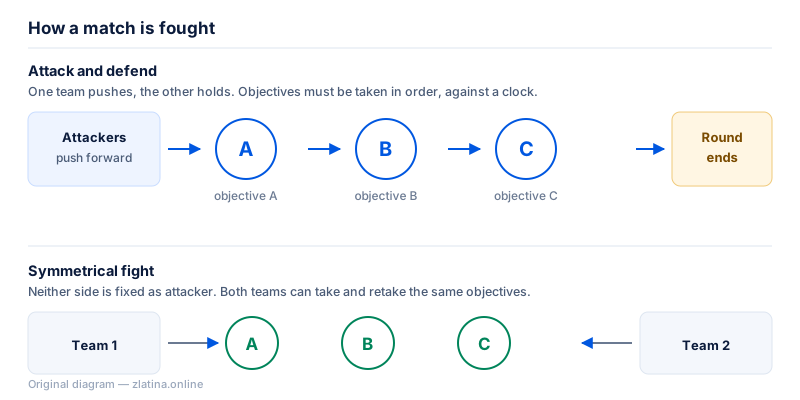
Attack and defend
One team is the attacker and must capture a sequence of objectives in a fixed order. The other team holds. A clock runs, and time is usually added when the attackers take a point. If the attackers run out of clock, the defenders win by default.
This asymmetry is the important bit. As an attacker, standing still loses. As a defender, trading ground slowly is a perfectly good way to win — you do not have to retake anything, you only have to be slow to give it up.
Symmetrical objective fights
Neither side is fixed as the attacker. The same objectives can be captured, lost and retaken by either team, and the round is decided by who holds what when the clock stops or when one side is exhausted. Here, giving ground is not a delaying tactic — it is just losing ground.
A third shape turns up occasionally: modes that take the squad system away and give you one soldier with one life at a time. They are a different game, and worth trying once precisely because they show you how much the squad system was doing for you.
How objectives are actually taken
Capturing is a presence mechanic: soldiers inside the capture zone progress the capture, and enemies inside it contest or stop it. Because you field a squad rather than a single soldier, you can meaningfully influence a capture on your own — and so can one enemy who sneaks in, which is why an uncontested capture is rarer than it looks.
- Bodies count. Bringing a full infantry squad onto a point does more than bringing one very good soldier.
- Clearing is not holding. Killing the defenders does nothing until someone is standing in the zone.
- The fight after the capture is the real one. Objectives are usually lost in the first minute after they change hands, before the new holders have anywhere to deploy from.
Rally points, and why engineers decide rounds
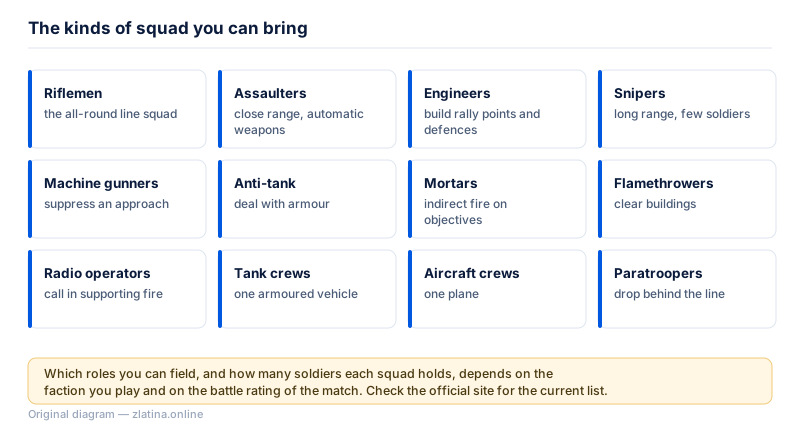
Engineer squads can build, and the structure that matters most is a forward rally point: a place your squads can deploy from that is closer to the fighting than the default spawn. The arithmetic is brutal and simple. If your team walks forty seconds to the objective and the enemy walks ten, you lose, and no amount of individual skill fixes it.
- Build the rally point behind cover and off the obvious approach. One that is visible from the objective gets destroyed immediately and wastes the build.
- Build it before you need it, not after your team has been pushed off a point.
- If you are defending and losing ground, the enemy has a rally point somewhere near. Finding and destroying it does more than winning a gunfight.
Engineers can build other things too — defences, ammunition, anti-tank obstacles. Those matter, but none of them changes a round the way deployment distance does.
Tanks and aircraft in the same match
Vehicle squads work differently from infantry squads: a tank crew is effectively one tank, and an aircraft crew is one plane. You bring them as part of the same lineup, which means the decision to take a vehicle squad is a decision not to take an infantry squad.
Two things follow. First, a tank that sits at the back achieving nothing is a squad your team does not have on the objective. Second, anti-tank squads and anti-tank equipment are not a niche pick — they are the answer to a problem that appears in most matches. If nobody on your team can deal with armour, armour decides the round.
You are leaving zlatina.online for the advertiser's own page. If you register there, BRIGÁDA 972 s.r.o. receives a commission from the advertiser. It costs you nothing extra and it does not change anything written above.
Practice and custom matches
Practice against bots and custom matches exist and are useful, but be honest with yourself about what they are for: learning a map layout, testing a weapon, or working out where a rally point can be hidden. Bots will not teach you how real defenders behave.
What changes between updates — and what we are not claiming
Mode rotations, mode names, capture timings, build limits and vehicle availability are all things a patch can change. This page describes the structure of matches, which has been stable, and deliberately avoids quoting:
- the number of players per side in any mode;
- capture times, build costs or rally-point limits in seconds or units;
- whether the mode names listed above are all currently in rotation;
- map counts.
For any of those, the update notes on the official site are the authority, and in case of divergence the publisher’s information prevails over this page.
Published 21 September 2026 by William Cooper for BRIGÁDA 972 s.r.o.. Diagrams on this page are original work. Enlisted is a product of Darkflow Software, published by Gaijin Entertainment; zlatina.online is not affiliated with, endorsed by or sponsored by either. Found an error? Tell us — corrections are logged on the corrections page.